

Building Energy Rating
BUILDING ENERGY RATING CERTIFICATES. (DOMESTIC AND NON-DOMESTIC)
We are trained and registered with Sustainable Energy Ireland to provide BER Certificates for both domestic and non domestic building.
An Advisory report is also issued with the BER Certificate highlighting cost effective improvement that can be made to the building to improve its energy efficiency.
Contact us today for a competitive quote.
WHAT IS A BER (BUILDING ENERGY RATING)?
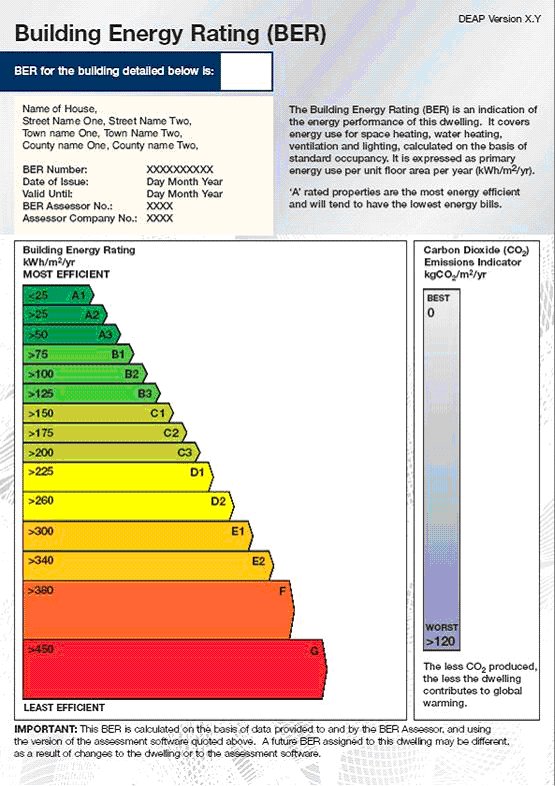
A BER is similar to the energy label for a household electrical appliance such as fridge or washing machine.
The label has a scale from A to G.
An A rated property is the most efficient and a G rated properties the least.
Each BER issued is accompanied by an Advisory report which will consist of a list of cost effective energy improvement that can be made to the building.
It will allow buyers and tenants to take the energy performance of the building into consideration, prior to purchasing or renting it.
The more energy efficient the building is, the lower the running costs will be.
Only Registered SEI (Sustainable Energy Ireland) Assessors can issue BER certificates
WHO NEEDS A BER?
A seller/landlord must provide a BER certificate to prospective buyers or tenants when a property is constructed, sold or rented under the following circumstances
1) New domestic buildings for which planning permission was applied for on or after the 1st of January 2007. Transitional BER exemptions will apply to building that planning permission was applied for on or before 30th of June 2008, which are substantially completed prior to 30th June 2010
2) New non-domestic buildings for which planning permission was applied for on or after 1st of July 2008. Transitional BER exemptions will apply to building that planning permission was applied for on or before 31st of December 2006, which are substantially completed prior to 30th June 2008.
3) All domestic or non-domestic building in existence at 1st of January 2009 offered for sale or rent on or after 1st of January 2009.
A new self build home (even when not for sale) must have a BER certificate before they are occupied.
SELLING PROPERTIES OF PLANS AND SPECIFICATIONS?
If a building is sold of plans before it is fully constructed then the seller must produce a Provisional BER certificate to the prospective buyer, A Provisional BER certificate is valid for to 2 years.
It must be followed up by a full BER certificate once the building is fully constructed.
The full BER certificate will take into account any changes or alterations made during construction.
WHAT ARE THE IMPLICATIONS OF NOT OBTAINING A BER CERTIFICATE?
The penalty for not obtaining a BER certificate is, subject to conviction by a District Court of a fine not exceeding €5,000, or a prison sentence not exceeding 3 months or both.
It may also delay the legal completion of a letting agreement or sale of the property.
HOW LONG WILL A BER CERT REMAIN VALID?
A BER certificate for a building will be valid for 10 years from the date of issue, unless there is a material change in the building in the meantime, which would affect its energy performance.
For example an extension to the building or a change to the heating system or fuel used would require a new BER Certificate.
Therefore if a property that has previously received a BER certificate is placed on the market within 10 years of that BER being issued, and the property has experienced no material alteration in the meantime, then the same BER may be used by the building owner for the purposes of meeting their obligations under the regulations.
HOW CAN A BER BE IMPROVED?
The energy performance of a building can be improved by
1) Reduce the heat loss through the building fabric i.e. install double glazing or increase cavity wall insulation.
2) Install a more efficient heating system such as changing from electric heaters to oil or gas.
3) Upgrade the heating controls of the building such as zoning the building into different areas with separate time and temperature controls.
4) Install renewable heating technologies such as heat pumps, solar panels, and wood pellet boilers.
5) Switch to an energy efficient lighting system.
The length of time that it will take to recover these improvement costs can also be estimated.
|
News |
|
|